
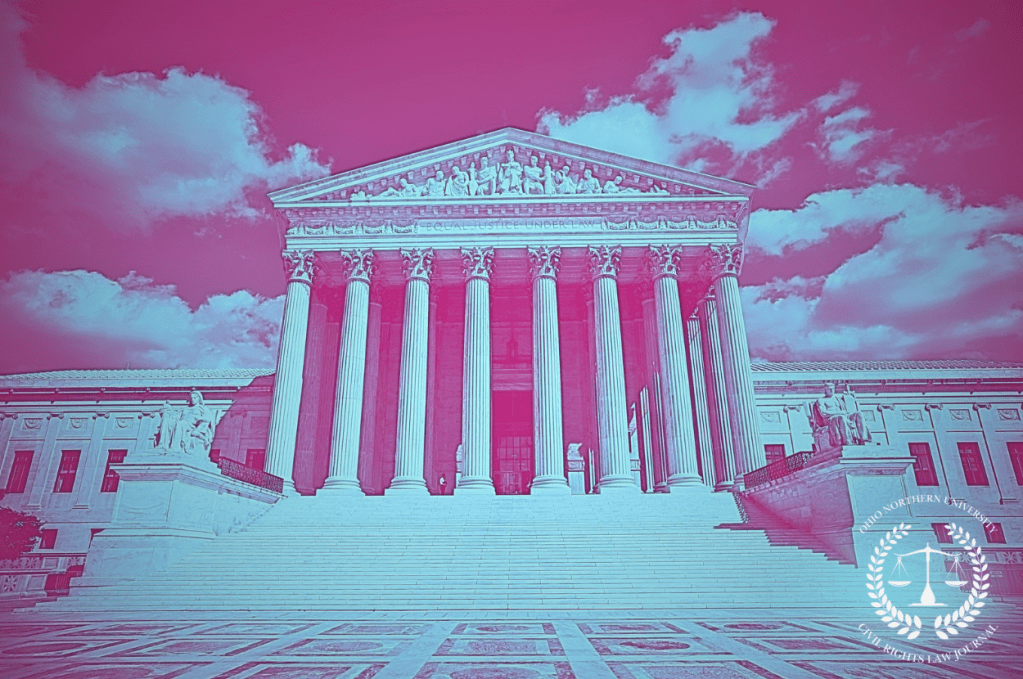
SCOTUS Rules That States May Limit Women’s Sports to Biological Females
By Kathryn Hancock
The lack of a nationwide ban allows states to choose, leaves unresolved legislation in California, Connecticut
On June 30, 2026, the Supreme Court of the United States (SCOTUS)1 issued its long-awaited decisions in West Virginia v. B.P.J.2 and Little v. Hecox.3 SCOTUS decided both transgender cases in a single opinion. The Court held that states may limit participation on women’s and girls’ school athletic teams to biological females without violating Title IX. The Court was split 6–3 on the Equal Protection issue under the U.S. Constitution; it was in full agreement (9–0) that Title IX had not been violated.
The ruling permits states to ban transgender women and girls from competing in female school sports.
The Ohio Northern University Civil Rights Law Journal previously covered this topic in a June 2026 article, “Collision of Rights: Do Transgender Athlete Cases Expand or Challenge the Purpose of Title IX?” The article explored the competing arguments over whether Title IX protects athletic participation based on biological sex or gender identity, presenting both proponents’ and opponents’ perspectives while predicting that the Supreme Court’s decision would redefine the next chapter of women’s athletics.
West Virginia v. B.P.J. challenged a 2021 West Virginia law requiring participation in public middle school, high school, and college-level athletic teams to be based on biological sex. And Little v. Hecox challenged Idaho’s 2020 law, the nation’s first statewide ban on transgender women competing in women’s college sports.
Justice Kavanaugh delivered the opinion of the Court, which concluded that the term “sex” in Title IX refers to the ordinary biological meaning when Congress enacted the law in 1972. Kavanaugh wrote that states have important governmental interests in promoting competitive fairness and athletic safety, and concluded that the challenged laws do not violate either Title IX, which prohibits sex discrimination in federally funded education programs, or the Equal Protection Clause of the Fourteenth Amendment. The ruling permits states to maintain separate athletic teams for biological females.
Justice Sotomayor delivered an opinion concurring in part and dissenting in part, joined by Justices Kagan and Justice Jackson, who wrote a separate opinion. The dissent argued that the Court acted prematurely and emphasized that heightened scrutiny requires a deeper review. The dissent continued that categorical bans fail to treat citizens as individuals and instead treats them as mere components of a class.
This decision represents one of the Supreme Court’s clearest statements that, for purposes of women’s athletics under Title IX, states may define eligibility based on biological sex. As a result, states that have enacted similar laws may exclude transgender girls and women from female athletic teams.
However, the ruling does not require every state to adopt these restrictions. Instead, the Court held that states may choose to adopt policies based on biological sex without violating Title IX. States that have not enacted such laws may continue allowing transgender athletes to compete according to their gender identity unless a court later rules otherwise. For this reason, in states such as California and Connecticut, where transgender athletes are permitted to compete consistent with their gender identity, litigation challenging those policies remains unresolved.
What You Can Do
- Read the Ohio Northern University Civil Rights Law Journal article, “Collision of Rights: Do Transgender Athlete Cases Expand or Challenge the Purpose of Title IX?”, to explore the competing legal arguments that preceded the Supreme Court’s decision.
- Read the Supreme Court’s opinions in West Virginia v. B.P.J. and Little v. Hecox to understand the Court’s reasoning and follow how lower courts apply the ruling in future Title IX and Equal Protection cases.
- Monitor ongoing litigation in states such as California and Connecticut, where transgender athletes are still permitted to compete consistent with their gender identity. Legal challenges to those policies remain pending.
Endnotes
- West Virginia v. B.P.J., 609 U.S. (2026).
- B.P.J. v. W. Va. State Bd. of Educ., 98 F.4th 542 (4th Cir. 2024).
- Hecox v. Little, 104 F.4th 1061 (9th Cir. 2024).
* Denotes links requiring a subscription
Suggested Citation
Hancock, Kathryn, Update: Supreme Court Says State Bans Don’t Violate Title IX (July 28, 2026). Ohio Northern University Civil Rights Law Journal. Available at https://onucrjournal.com/2026/07/28/story-update-supreme-court-says-bans-dont-violate-title-ix/.
 Ohio Northern University
Leave a comment