
When are you entitled to your Miranda rights?
By Courtney Bailey
EDITOR’S NOTE: Know Your Rights is a regular series of the ONU Civil Rights Law Journal. Have a suggestion? Email the Editor at onucivilrightslawjournal@gmail.com
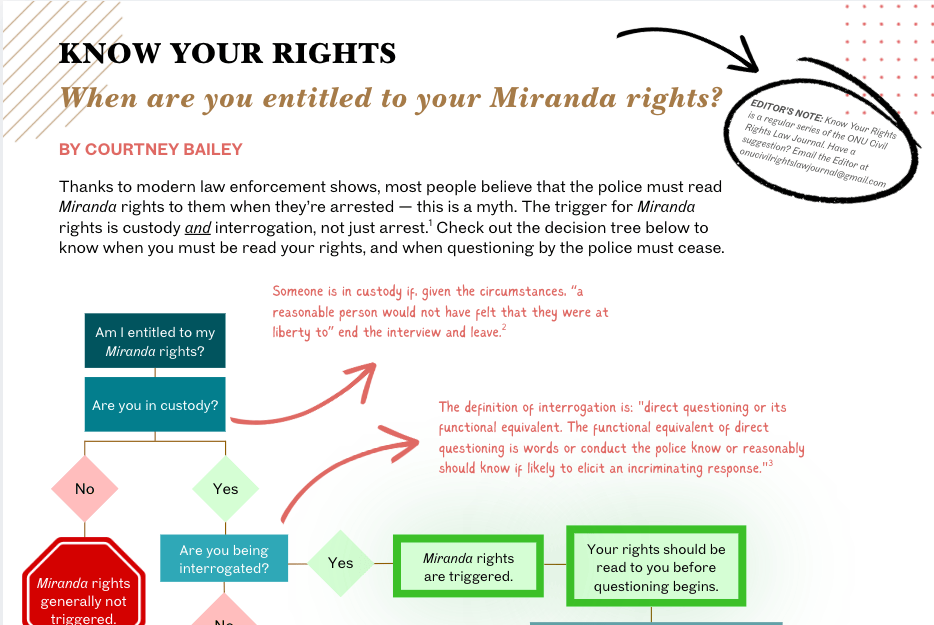
Thanks to modern law enforcement shows, most people believe that the police must read Miranda rights to them when they’re arrested — this is a myth. The trigger for Miranda rights is custody and interrogation, not just arrest.1 Check out the decision tree below to know when you must be read your rights, and when questioning by the police must cease.
Sources
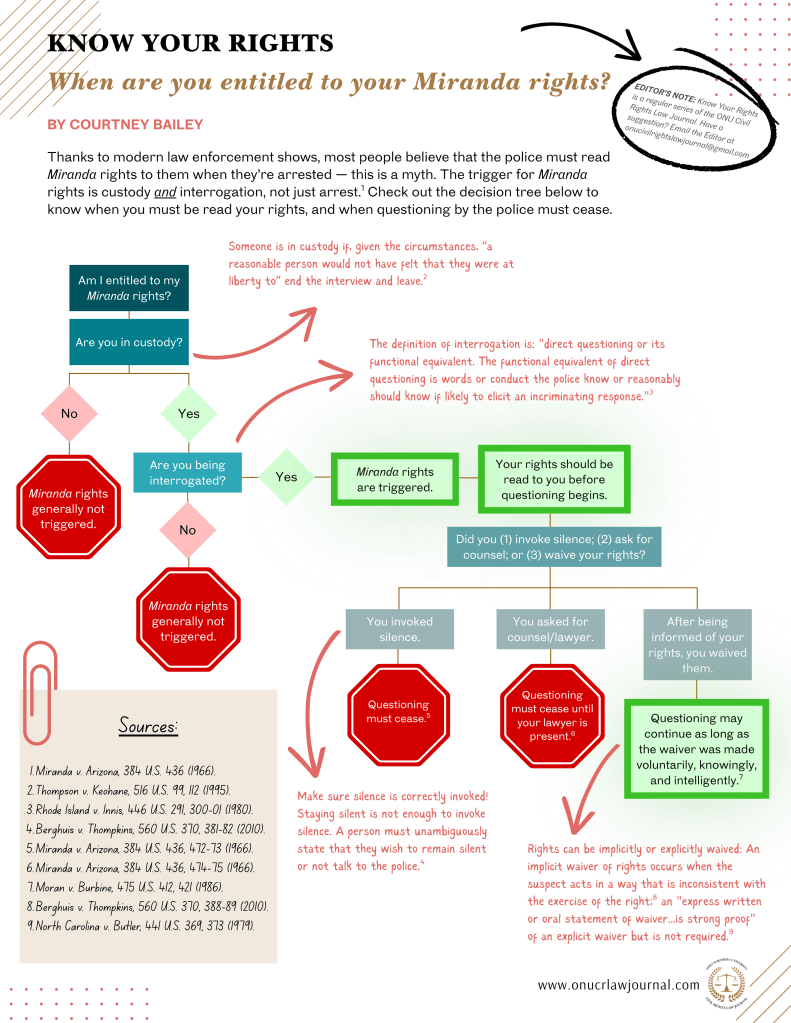
1North Carolina v. Butler, 441 U.S. 369, 373 (1979).
2Miranda v. Arizona, 384 U.S. 436 (1966).
3Thompson v. Keohane, 516 U.S. 99, 112 (1995).
4Rhode Island v. Innis, 446 U.S. 291, 300-01 (1980).
5Berghuis v. Thompkins, 560 U.S. 370, 381-82 (2010).
6Miranda v. Arizona, 384 U.S. 436, 472-73 (1966).
7Miranda v. Arizona, 384 U.S. 436, 474-75 (1966).
8Moran v. Burbine, 475 U.S. 412, 421 (1986).
9Berghuis v. Thompkins, 560 U.S. 370, 388-89 (2010).
Suggested Citation
Bailey, Courtney, Know Your Rights: When Are You Entitled to Your Miranda Rights? (Oct. 23, 2026). Ohio Northern University Civil Rights Law Journal. Available at https://onucrjournal.com/2026/10/23/know-your-rights/.


Leave a Reply