

If it doesn’t, Ohio’s public schools will be left vulnerable to issues of segregation
As the Tenth District Court of Appeals debates the merits of Columbus City School Dist. v. State of Ohio, proponents of vouchers claim they are giving parents a choice in their child’s education, while critics say it is a modern-day segregation scheme.
By Marciana Auxier
* Denotes a link requiring a subscription
Ohio’s Tenth District Court of Appeals is expected to rule on the constitutionality of school voucher programs by the end of the year following oral arguments that were heard in May. The arguments followed a June 2025 ruling by the Franklin County Court of Common Pleas that declared Ohio’s voucher system as unconstitutional in Columbus City School Dist. v. State of Ohio. The voucher program remains in place until a decision is made on the matter. Scholarship voucher programs are “a government voucher or cash grant given to a parent or guardian to be used toward paying the fees for their child to attend a private or parochial school of choice,” says the website cgaa.org.
In 2024, a report from Cleveland.com noted Ohio had, at that time, spent nearly $1 billion dollars on school voucher programs,* with parents utilizing the scholarships to send their children to private schools. According to the Ohio Department of Education, following a request from the Ohio Northern University Civil Rights Law Journal in July, that number steadily increased to $1.17 billion dollars for the estimated fiscal year 2026 cost, with 107,512 participating students. The estimated cost for fiscal year 2027 will tick up to $1.26 billion dollars with an expected 113,962 students participating. Ohio’s Department of Education did not respond to the CRLJ’s request for an interview.

According to Judge Jaiza N. Page’s June 2025 decision, the plaintiffs’ primary argument in the Columbus case is that the EdChoice voucher program violates Article VI, Section 2 of the Ohio Constitution, which requires a “thorough and efficient” single system of common schools, by creating “a second system of uncommon, private schools.” The State argued in opposition that the EdChoice voucher program is establishing a system of scholarships versus a system of schools — an important distinguishing characteristic that pulls the state’s argument away from the Constitution’s clear language of a single system of education.
The Plaintiffs’ claims are not off-base. Ohio was the first state* in the Union to adopt the “thorough and efficient” standard for its public school systems in 1851, which several states subsequently adopted. In Bd. of Educ. v. Walter (1979)1*, the “thorough and efficient” standard was interpreted by the Ohio Supreme Court as such:
…the sovereign people made it mandatory upon the General Assembly to secure not merely a system of common schools, but a system thorough and efficient throughout the state…A thorough system could not mean one in which part or any number of the school districts of the state were starved for funds. An efficient system could not mean one in which part of any number of the school districts of the state lacked teachers, buildings, or equipment.2
This standard was how delegates to Ohio’s Second Constitutional Convention in 1851 attempted to ensure that the public education system remained funded and free from the touch of politics and religion. But critics argue vouchers circumvent that standard.
“While we profoundly respect the judicial process, we vehemently disagree with the court’s interpretation of Ohio’s Constitution and believe the EdChoice program remains a constitutionally sound mechanism to empower families,” said Eric Frank, President of School Choice Ohio and supporter of EdChoice, per statenews.org. The Court did not find the Plaintiffs’ claim of segregation and discrimination to have merit because they lacked sufficient evidence outside of the demographic makeup of the schools to show the discrimination. But the Court did say private schools “participating in the EdChoice program are not subject to anti-discrimination laws, giving them complete control over whether to enroll a prospective student, and allowing them to turn students away based on their religion, sexual orientation, or disability.”
In an effort to improve parent choice, critics argue voucher programs have created a segregated and unconstitutional education system that is pushing to create a religious-based, privatized school system. Per a report by nea.org, historically, vouchers have been used as a “workaround” for segregation after Brown v. Board of Education3 held racially segregated public schools unconstitutional in 1954. After Brown, southern states gave white families vouchers to attend schools of their choice, per a report by nea.org.
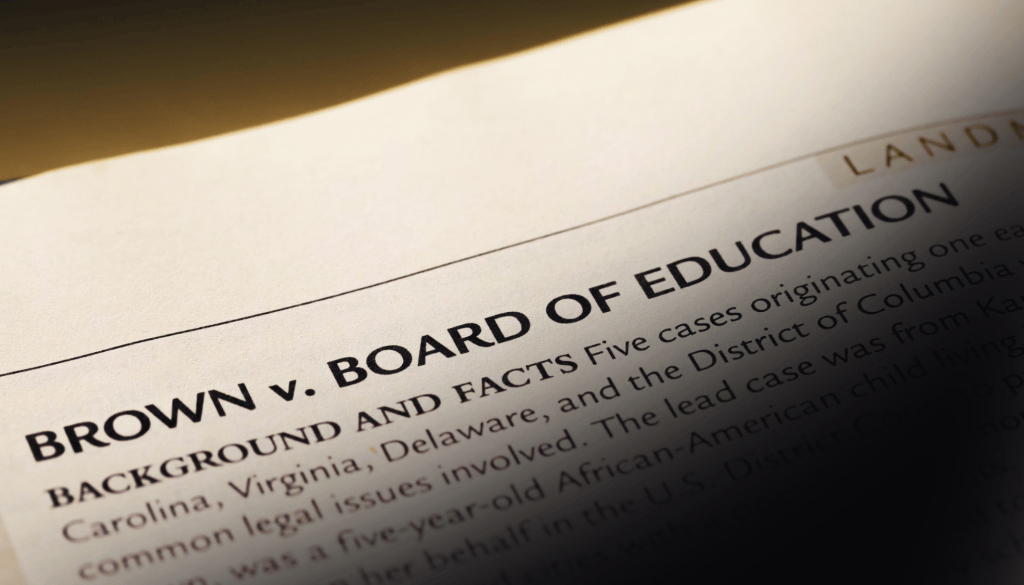
Rejecting students based on discretionary and discriminatory factors is something public schools are not allowed to do since the Civil Rights Act of 1964 was passed. “[R]eligious schools that accept…dollars are not required to satisfy the same requirements public schools must meet,” such as “accepting any and all students,” according to the Texas Observer. This allows private institutions to use public funding while keeping the privilege and discretion to choose who is allowed to attend their school, per an article from the Albert Shanker Institute. Voucher systems like EdChoice in Ohio are funneling public money into private institutions and, by doing so, are able to reject or accept who they want based on discretionary policies, which raises alarms for civil rights.
If taxpayer dollars are used to fund religious private schools who segregate based on protected classes, the question becomes whether this is a constitutional violation. According to LegalClarity.com, “even if funds pass through parents, the ultimate destination is often religious schools, which use public money to advance religious instruction.” This, opponents say, constitutes government support for religion, and when money is funnelled into private institutions in this manner it blurs the line between church and state.
Based on information from School Choice Ohio and the Ohio Department of Education, the EdChoice Scholarship Program implemented in 2005 has expanded over the years to include the EdChoice Expansion Program, which initially was designed to offer scholarships to students in “low-performing” schools and to give them the choice to receive a private education. Additional Ohio voucher programs include Traditional EdChoice, Cleveland, Autism, and JSPN scholarship programs.
The “parent choice” concept was born out of funding disparity in Ohio’s public schools, specifically in Cleveland, where failing schools, high-poverty areas, and racial tensions aligned to expose property tax funding issues across the state. The argument in Cleveland at that time was that children attending schools in property-rich areas received more dollars and better education than children attending schools in property-poor areas. Additionally, while some taxpayers voted for increased levies to support schools, other communities struggled for support. These disparities created pain points for Ohio parents who wanted a better education for their children, but could not afford the property-rich areas of town.
That issue has proven to be ubiquitous across the United States.
“The history of education since the industrial revolution shows a continual struggle between two forces: the desire by members of society to have educational opportunity for all children, and the desire of each family to provide the best education it can afford for its own children,” wrote Coleman in Foreword to Strayer-Haig, The Financing of Education in the State of New York (1923), at vii.
The constitutionality of school voucher systems is not just an issue in Ohio. States like Montana, per the Institute of Justice, have encountered constitutional clashes with state-funded voucher programs as well. The Supreme Court of the United States (SCOTUS) decided on the constitutionality of Montana’s voucher program in Espinoza v. Mont. Dep’t of Revenue4.
Montana set up a system where taxpayers who donated to private schools participating in the scholarship program received a tax credit for their donations. These donations were then used for scholarships for children’s tuition at private schools.
The issue in this case centers around the “no aid” provision in Montana’s constitution, prohibiting scholarships from being used at religious schools; as a result, the Montana Supreme Court ruled it to be unconstitutional. Montana’s Department of Revenue promptly implemented a rule that these scholarships could not go to private schools with religious teachings. Three mothers were then prevented from using the scholarship funds awarded to their children at the school of their choice because of the school’s religious teachings. It was later appealed, and SCOTUS ruled that Montana’s “no aid” provision was directly in violation of the Free Exercise Clause of the Federal Constitution.
According to Espinoza, the Free Exercise Clause “‘protects religious observers against unequal treatment’ and against ‘laws that impose special disabilities on the basis of religious status.5’” The Supreme Court held that Montana’s “no aid” aspect of its state constitution cuts families off “from otherwise available benefits if they choose a religious private school rather than a secular one, and for no other reason,” other than the fact that it is a religious school.
Per Capital University Law School Professor Nathaniel M. Fouch in The Education Wars Return to Ohio, “…states don’t have to subsidize private education, [but] if a state ‘decides to do so, it cannot disqualify some private schools solely because they are religious.’”
The reasoning behind the decision in Espinoza centers around the Supremacy Clause, which mandates that states rule in accordance with the federal Constitution rather than their own state constitution if there is a conflict or contradiction between the two. The Supreme Court held Montana’s Supreme Court should have disregarded the “no aid” provision of its constitution and upheld the Free Exercise Clause of the United States Constitution to permit funding to go to every private school. Ohio is facing a similar challenge with the EdChoice scholarship voucher system in Columbus City School Dist. v. State of Ohio. Based on prior Supreme Court decisions in states such as Montana, EdChoice may be here to stay.
What started as a concern for parents to have a choice in their child’s education has become a legal clash with the fundamental civil rights concepts of the separation of church and state, segregation, and the Free Exercise Clause of the Constitution. Ultimately, voucher critics say programs like EdChoice could cause the end of the public education system as we know it, and it is up to the public to take a stand. Voucher proponents say parents have a right to choose their child’s education. No matter which side you stand on, Ohio needs to cure its public education system and rework its voucher system.
What You Can Do
- Contact your Ohio representatives here: https://findmydistrict.ohiosos.gov/.
- Stay informed about recent legislation: https://legislature.ohio.gov/legislation/acts/136.
- Form a coalition with individuals in your community and speak out for or against pressing concerns you may have.
- Read more about how the voucher system can lead to a privatized system of education here: https://fixohioschools.org/.
- Read about House Bill 671 that would cut funding to the schools involved in the lawsuit in Ohio, here: Ohio bill would cut funding to school districts suing over vouchers – cleveland.com. According to the Bill: “The department of education and workforce shall withhold state foundation funding calculated under this chapter for any school district that is a complainant or a member of a complainant in a legal action against the state that challenges or otherwise seeks to change, invalidate, or declare void the calculation or distribution, or both, of foundation funding under this chapter, including funding for state scholarship programs as defined in section 3301.0711 of the Revised Code.”
Endnotes
* Denotes a link requiring a subscription
1 Bd. of Educ. v. Walter, 390 N.E.2d 813 (Ohio 1979).
2 Bd. of Educ. v. Walter, 390 N.E.2d 813, 825 (Ohio 1979).
3 Brown v. Bd. of Educ., 347 U.S. 483 (1954).
4 Espinoza v. Mont. Dep’t of Revenue, 591 U.S. 464 (2020).
5 Espinoza v. Mont. Dep’t of Revenue, 591 U.S. 464 (2020) (quoting Trinity Lutheran Church of Columbia, Inc. v. Comer, 582 U.S. 449, 458 (2017)).
Suggested Citation
Auxier, Marciana, “Unconstitutional” Ohio school voucher ruling in Franklin County may not stick on appeal, (Sept. 18, 2026). Ohio Northern Civil Rights Law Journal. Available at https://onucrjournal.com/2026/09/18/unconstitutional-ohio-school-voucher-ruling-in-franklin-county-may-not-stick-on-appeal/.
 Ohio Northern University
Leave a comment