

The National Guard and its Chilling Effect on the First Amendment
By Kaitlyn Cieply
In June 2025, U.S. President Donald Trump issued a presidential memorandum titled, “Department of Defense Security for the Protection of Department of Homeland Security Functions” which authorized the activation and deployment of the National Guard, purportedly to quell domestic civil unrest following his aggressive immigration enforcement policies. In December 2025, the Supreme Court found the activations and deployments unlawful, but the First Amendment question remains.
The president took a hard-line stance against illegal immigration and implemented a number of policies designed to fast-track deportations. These policies ignited protests across the nation and resulted in the National Guard activation in June 2025. According to the president, protesters were engaging in acts of “violence and disorder” that were tantamount to a “rebellion.” Based on that logic, he authorizedmore than 2,000 National Guard to be called into federal service anywhere in the U.S.
Download the article below
The National Guard deployments can seem confusing because they can be authorized under a variety of different legal authorities. Think of it this way, the National Guard cannot march unless it puts on a hat, but its commander can give it any one of three different hats, based on the statutory authority it is activated and deployed under: 1) the State Active Duty (SAD) hat, 2) the Title 32 hat, or 3) the Title 10 hat. The SAD hat is when the National Guard is being used for state functions, at the request of the governor, and are generally governed by state laws. The Title 32 hat is when the National Guard is used for federal missions authorized by Congress. National Guard wearing that hat are under state command and are bankrolled by the federal government.
We know these two hats are still hanging on the rack because the governors were against the National Guard being used in this way and Congress had not authorized the mission. That leaves Title 10, but the president cannot place this hat on the National Guard’s head unless the statutory requirements of 10 U.S.C. § 12406 are met. Without an actual or threatened invasion or rebellion, or when there are conditions which prevent the president from executing the laws with the regular forces, the president cannot lawfully distribute Title 10 hats to the National Guard.
But the issues with these deployments go much further than whether the statutory conditions were met. That the president activated and deployed the National Guard in response to speech, and what was largely a peaceful assembly, presents a chilling effect on the exercise of First Amendment Rights. When protests are executed peacefully, there is no legal basis for government intervention, and any such intervention would be considered a violation of the First Amendment. But First Amendment rights are not the only ones in danger. As observed in Bissonette v. Haig1,
“military enforcement of the civil law leaves the protection of vital Fourth and Fifth Amendment rights in the hands of persons who are not trained to uphold these rights. It may also chill the exercise of fundamental rights, such as the rights to speak freely and to vote, and create the atmosphere of fear and hostility which exists in territories occupied by enemy forces.”
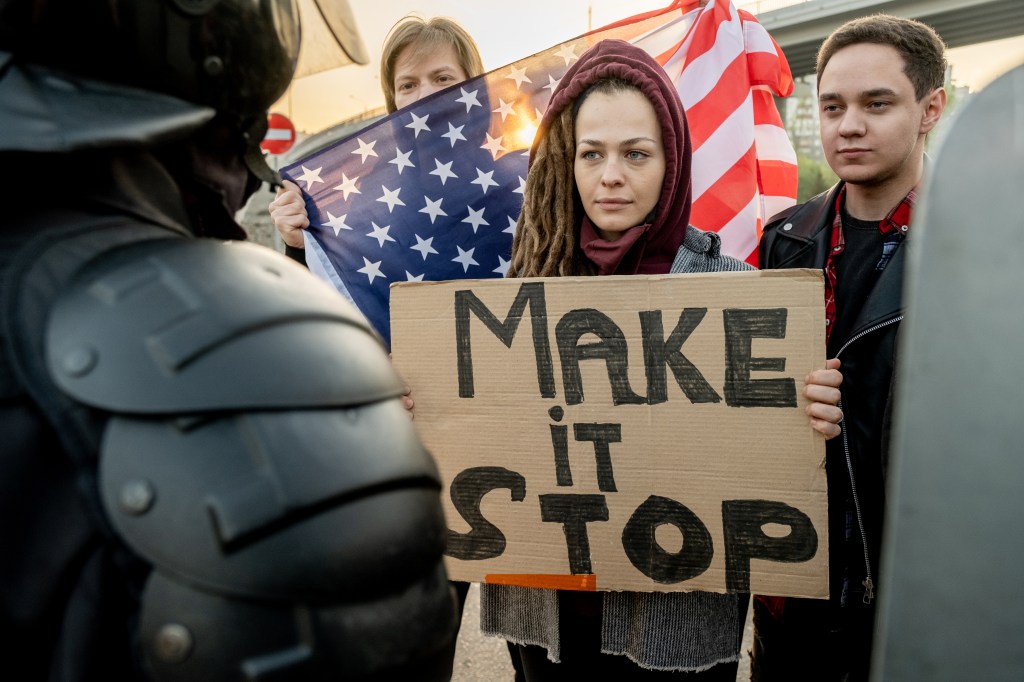
In our justice system, the way to fight attacks on freedom is to file suit in court. Over a period of several months during 2025, governors in California, Oregon, and Illinois filed suits challenging the national guard activations and deployments. The 9th Circuit7, standing alone, understood the president to have broad authority under the relevant statute. Under that “highly deferential standard of review,” because the president presented some supporting facts, the court “conclude[d] that the President had a colorable basis” for activating the national guard under Title 10. The U.S. District Court for the District of Oregon observed that “[t]he President’s determination was simply untethered to the facts.”2 Similarly, U.S. district courts in California3 and Illinois4, the 7th circuit5, and the Supreme Court6 all sided with the states.
How did this happen?
The Federal government has limited enumerated power and the Constitution shields civil rights. So how did this happen? The answers are, unfortunately, not simple. The Constitution is short and the Founders failed to include a dictionary. That makes it open to a variety of interpretations. Here, everyone is looking at the same constitution, but the federal executive branch is interpreting its power much differently than how the states understand it. As with any legal controversy, the issue of who is right is left to the courts to decide. Once there, lawyers and scholars tend to agree on very little except that, with Constitutional law issues, analysis begins with the text itself. This is where things get scaly.
The Constitution is a dinosaur – a pile of fossils left by the Founders. Scholars can study these pieces and try to derive meaning from surrounding sources, like the historical and philosophical vegetation the Founders fed America’s Constitutional dinosaur, but analysis based on text alone is limited. Instead of producing a living, breathing, animal, scholars might be lucky to produce a black and white sketch. Now, consider the book “Jurassic Park.” The scientists extracted DNA from a fossil, but it was not enough on its own. They needed frog DNA to fill gaps in dinosaur DNA, just like jurists use case law to fill gaps in the Constitution.
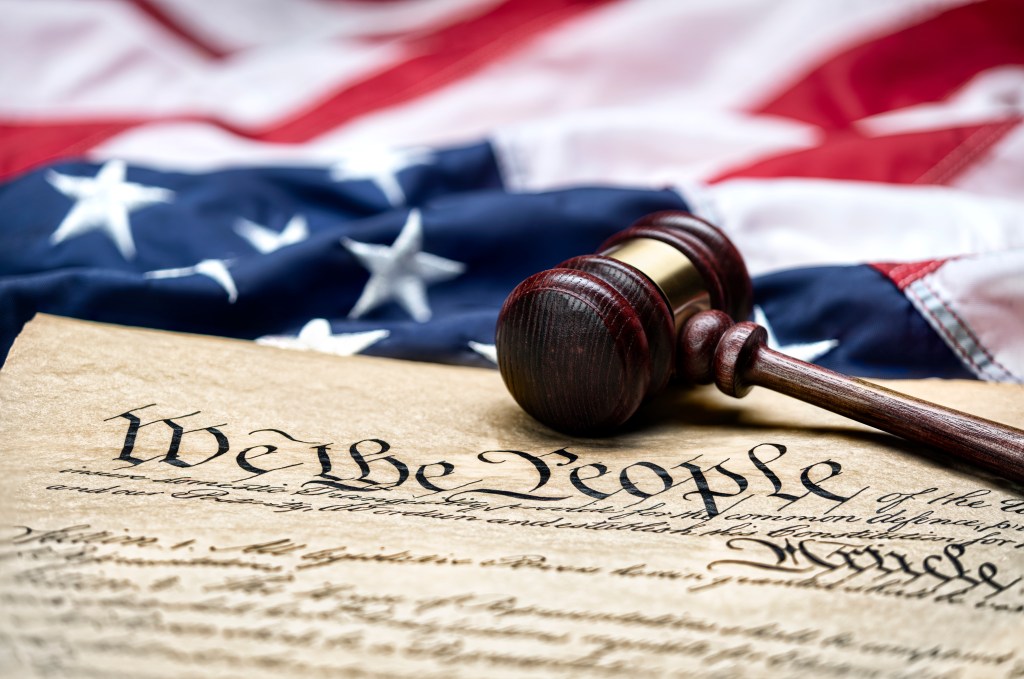
The First Amendment says: “Congress shall make no law respecting an establishment of religion, or prohibiting the free exercise thereof; or abridging the freedom of speech, or of the press; or the right of the people peaceably to assemble, and to petition the Government for a redress of grievances.” The purest of textualists might stop there and surmise that a president is incapable of violating it because they are not Congress. Everyone else would cite cases like New York Times Co. v. United States8 to show that the First Amendment can constrain presidential action as well.
But wait, there’s more frog DNA to analyze. United States v. O’Brien9 held, when there is conduct containing both speech and nonspeech elements, the government could regulate the nonspeech element, even if it created an incidental limitation on protected speech: “if 1) the regulation is within the constitutional power of the government, 2) the regulation furthers an important or substantial governmental interest, 3) the governmental interest is unrelated to the suppression of free expression, and 4) the incidental restriction on alleged First Amendment freedoms is no greater than is essential to the furtherance of that interest.”
Courts looking at the 2025 National Guard deployments have sidestepped the First Amendment issue – choosing to decide on the merits of the National Guard activations and deployments instead. Courts who do reach this issue should find in favor of petitioners, because the federal government has not shown it has met the standards to regulate speech. But this does not mean the government can never regulate speech.
It is important to realize this could happen again with varying results based on what conduct protesters engage in. Americans should exercise caution. The abridgement of the First Amendment is only wrong here because there was not actually a rebellion. Had the president’s rebellion determination been tethered to actual facts, the chilling effect on the exercise of First Amendment rights could have been lawful. Beyond that, a revolution would give the president cause to lawfully activate any branch of the armed forces to execute domestic laws.
What You Can Do
For those courageous enough to exercise it, the First Amendment right to free speech and peaceful assembly remains a viable method for recourse. Publicly showing disdain for executive policies should amount to a call of action for representatives in Congress. In response, they should act. If they will not, Americans can elect new representatives. The current Congress might not choose to act. However, this Congress does not exist in perpetuity. Members of Congress retire, die, and their ranks are backfilled with U.S. citizens.
The most productive thing Americans can do to protect their freedoms is prepare to fill those roles and/or make educated decisions as to whom to entrust with their representation. In his Constitution Day remarks* in 2025, Ohio Northern University Law Professor Dan Maurer identified in his blog eight ways this can be done.
- First, recognize pluralism is greater than tribalism. Democracy dies in an echo chamber, but it thrives in communities of diverse perspectives where respect is practiced and compromise can be achieved.
- Americans should practice community engagement rather than isolationism.
- Americans should recognize that “[t]yranny of the minority is still a tyranny.”
- Americans should choose leaders for their expertise and experience rather than passion and ignorance.
- Americans should place a greater level of importance on preventing and mitigating present and future harms rather than trying to avoid action because of historical practices, traditions, or to otherwise preserve the status quo.
- Americans must understand that “[r]especting and enforcing the rule of law requires understanding the constraints, freedoms, rights, and governing structure and processes that sustain the rule of law.”
- Americans should exercise their ability to recognize and call out what Professor Maurer characterizes as “untruths and bullshit” and hold its proponents accountable for it.
- Finally, “[n]ot all beliefs deserve equal credence or deserve matching moral weight.” “[T]he most basic, axiomatic civic value” is that no matter how vile someone thinks another human’s beliefs are, it is “never justified, never humorous, never meme-worthy” to use violence against a fellow human.
Read the full Academic article here.
Explore this topic more here.
Endnotes
1. Bissonette v. Haig, 776 F.2d 1384 (8th Cir. 1985).
2. Oregon v. Trump, 3:25-cv-1756, 2025 U.S. Dist. LEXIS 197039 (D. Or. Oct. 4, 2025).
3. Newsom v. Trump, 797 F.Supp 3d 1092 (N.D. Cal. Sept. 2, 2025).
4. Illinois v. Trump, No. 1:25-cv-12174, Opinion & Order (N.D. Ill. October 10, 2025).
5. Illinois v. Trump, 155 F.4th 929 (7th Cir. 2025).
6. Trump v. Illinois, 607 U.S. ____ (2025).
7. Newsom v. Trump, 141 F.4th 1032 (9th Cir. 2025).
8. New York Times Co. v. United States, 403 U.S. 713 (1971).
9. United States v. O’Brien, 391 U.S. 367 (1968).
* Denotes links requiring a subscription
 Ohio Northern University
Leave a comment